A project organised by the Venice International Foundation and Friends of Venice Italy Inc.
Alberto Craievich
Head of the Department of Drawings and Prints at the Correr Museum
The Correr Museum’s Department of Drawings and Prints houses an extraordinary record of Neoclassical art and culture in Italy. This is the Cicognara Album, named after its owner, Count Leopoldo Cicognara (Ferrara 1767 – Venice 1834), one of the most fascinating figures of the era.
The Correr Museum’s Department of Drawings and Prints houses an extraordinary record of Neoclassical art and culture in Italy. This is the Cicognara Album, named after its owner, Count Leopoldo Cicognara (Ferrara 1767 – Venice 1834), one of the most fascinating figures of the era.
In 1808, he became president of the Academy of Fine Arts in Venice, a post he held even after Napoleon’s fall, until 1826. A cultured and brilliant man, particularly active in the city’s cultural life and beyond, during his tenure at the Venetian institution he published his principal works, including the monumental *History of Sculpture* and *The Most Notable Buildings of Venice*. He was responsible for major initiatives such as the organisation of the Gallerie dell’Accademia, which were taking shape at that very time with the arrival of paintings from places of worship that had been suppressed by Napoleonic decree. He conceived the so-called ‘tribute from the Venetian provinces to Austria’, thanks to which the 10,000 zecchini owed by the Veneto as a gift for the Emperor’s wedding were converted into works of art commissioned from local artists. Furthermore, he was the driving force behind the international fundraising campaign to erect the Canova monument at the Frari upon the death of the great sculptor, about whom he also wrote a seminal biography.
This album, a sort of *liber amicorum* comprising 81 sheets, bears witness to his close friendship with the artists of his time. It features all the leading figures of Italian Neoclassicism: Vincenzo Camuccini, Andrea Appiani, Giuseppe Bossi and the young Francesco Hayez; but also French artists such as François-Marius Granet, Lancelot Théodore Turpin de Crissé and Louis Léopold Robert.
No fewer than six sheets belong to his lifelong friend: Antonio Canova, of whom Cicognara was a passionate admirer.
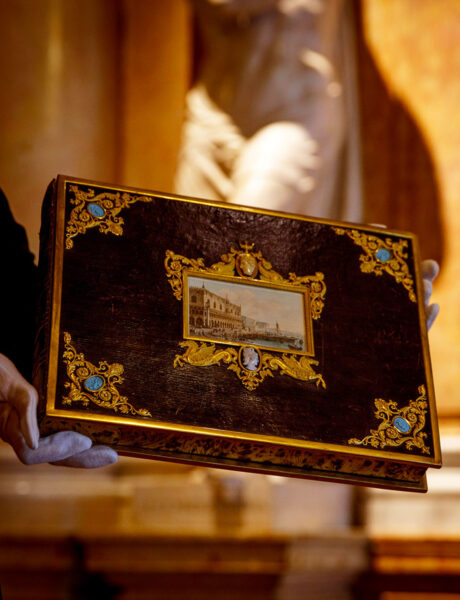
All the drawings are bound in a sumptuous volume, decorated with bronze friezes depicting floral motifs, sea horses and dolphins, which frame cameos from various periods and, in the centre, a delightful miniature depicting a view of Venice.
The sheets document every graphic technique and every conceivable subject. There are pencil, pen, coloured chalk and watercolour drawings depicting views, portraits, landscapes, genre scenes, and both sacred and secular compositions. We find preparatory studies for major works alongside ‘finished’ drawings executed specifically for Cicognara. Taken as a whole, it is a unique collection, given both the collector’s political and cultural role and the number of artists represented, reflecting all the artistic schools of the period. This precious volume, brought to the attention of scholars by Alvar Gonzáles-Palacios in 1970, was presented to the general public in 1978, on the occasion of the exhibition *Venice in the Age of Canova*. On that occasion, the sheets from the album were ‘removed’ and mounted in passe-partouts.
Today, forty years on from that event, there are significant conservation issues that require appropriate restoration work to be carried out on the entire collection of drawings.
The condition of the drawings varies greatly from one sheet to another. The work ranges from simple maintenance to delicate restoration procedures for sheets corroded by iron-gall ink. Furthermore, in most cases it will be necessary to deacidify the backing sheets onto which the original drawings are mounted. Finally, all the old passe-partouts, now damaged by the passage of time, are to be replaced.
